Rhythm: Place the Beat and the Rest
Many self-guided learners treat rhythm as secondary to pitch, yet rhythm is what tells the ear which notes belong to the structural harmony and which notes are decorative passing tones. To read and write rhythm comfortably, distinguish three layers of time: the steady underlying pulse (tactus), the grouping of pulses into strong and weak accents called meter, and the inner division of each pulse into two or three smaller parts called subdivision.
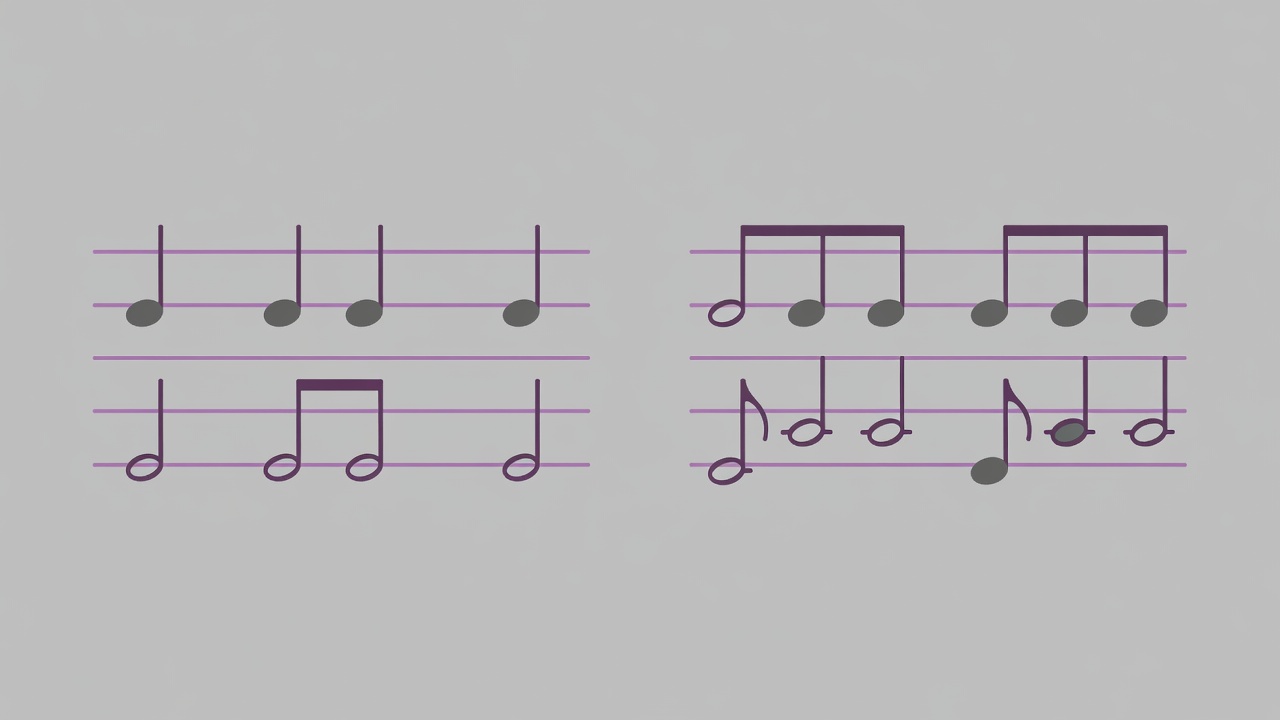
Figure 1.1: Both 3/4 and 6/8 contain six eighth notes per bar, but 3/4 divides three beats into twos (1 + 2 + 3 +), whereas 6/8 divides two beats into threes (1 la li 2 la li).
Why 3/4 and 6/8 Feel Completely Different
A classic point of confusion in music theory is why 3/4 and 6/8 are not interchangeable even though simple arithmetic says 3/4 equals 6/8. In musical notation, time signatures are not fractions. The top number in simple meter (2, 3, or 4) tells you how many main beats are in the bar, with each beat dividing naturally into two halves. In compound meter (where the top number is 6, 9, or 12), the main beat is a dotted note that divides naturally into three equal parts.
| Time Signature | Meter Classification | Main Tactile Beat | Subdivision per Beat |
|---|---|---|---|
| 2/4 | Simple Duple | 2 Quarter-note beats | Each quarter divides into 2 eighth notes |
| 6/8 | Compound Duple | 2 Dotted-quarter beats | Each dotted quarter divides into 3 eighth notes |
| 3/4 | Simple Triple | 3 Quarter-note beats | Each quarter divides into 2 eighth notes |
| 9/8 | Compound Triple | 3 Dotted-quarter beats | Each dotted quarter divides into 3 eighth notes |
Show the Beat Clearly So the Eye Hears the Meter
Good rhythmic notation always reveals where the middle of the bar sits. Similarly, harmonic rhythm—the rate at which underlying chords change—usually aligns with the strong beats of the measure. Test how beaming and chord placement work together in the exercise below.
Suppose your melody has six eighth notes in a bar, and the harmony changes from C Major to G Major halfway through the measure (on the fourth eighth note). Which time signature and beaming matches that harmonic rhythm?