Intervals: Count and Compare the Distance
Every harmonic and melodic gesture begins with the relationship between two pitches. In Western notation, an interval name always has two parts: a numeric size (such as a third, fifth, or sixth) and a quality (Perfect, Major, Minor, Augmented, or Diminished). Learners often stumble when they try to determine an interval by counting keyboard semitones alone. If you only count four semitones above D, you might land on F♯ or G♭—yet D to F♯ is a Major Third while D to G♭ is a Diminished Fourth.
To avoid that trap, always work in two calm steps: first count the inclusive alphabetical letters from the bottom note to the top note, and only then measure the exact semitone span to refine the quality.
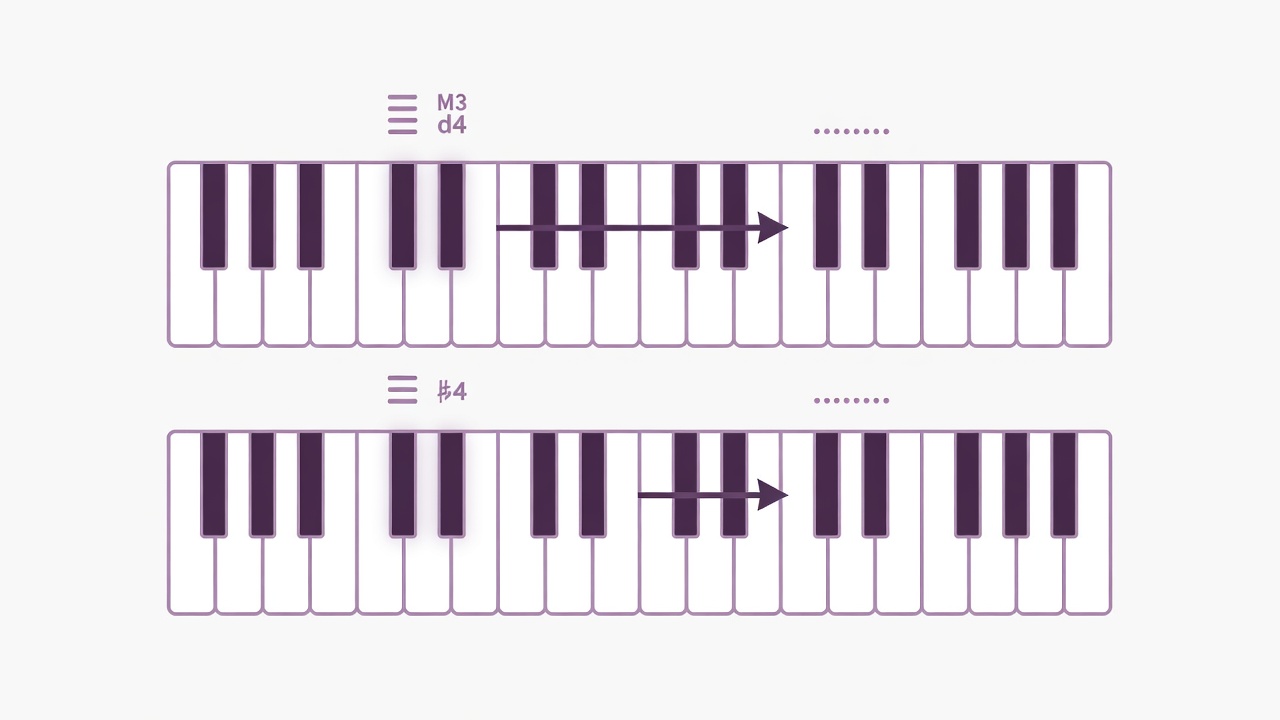
Figure 1.1: Both pairs span four semitones on the keyboard, but their staff letter counts (three letters vs. four letters) give them distinct harmonic duties.
Why Some Intervals Frame the Harmony While Others Colour It
Since the contrapuntal treatises of Gioseffo Zarlino (Le istitutioni harmoniche, 1558) and Johann Joseph Fux (Gradus ad Parnassum, 1725), musicians have divided intervals into three functional families:
- Perfect Consonances (Unison, Perfect 4th, Perfect 5th, Octave): Acoustically stable ratios (such as 2:1 for the octave and 3:2 for the fifth). They define the structural boundary of a chord or key but do not tell you whether the mode is major or minor.
- Imperfect Consonances (Major and Minor 3rds and 6ths): Rich, blended intervals that provide modal warmth. Moving in parallel thirds or sixths is one of the most natural ways to write a two-voice passage.
- Dissonances (2nds, 7ths, and all Augmented/Diminished intervals): Intervals that generate acoustic roughness or directional leaning, asking one voice to step smoothly into a neighboring consonance.
| Interval Name | Example Pair | Letter Count | Semitones | Inversion (Sum = 9) |
|---|---|---|---|---|
| Minor Second (m2) | C4 – D♭4 | 2 letters (C–D) | 1 semitone | Major Seventh (M7, 11 semitones) |
| Major Second (M2) | C4 – D4 | 2 letters (C–D) | 2 semitones | Minor Seventh (m7, 10 semitones) |
| Minor Third (m3) | C4 – E♭4 | 3 letters (C–D–E) | 3 semitones | Major Sixth (M6, 9 semitones) |
| Major Third (M3) | C4 – E4 | 3 letters (C–D–E) | 4 semitones | Minor Sixth (m6, 8 semitones) |
| Perfect Fourth (P4) | C4 – F4 | 4 letters (C–D–E–F) | 5 semitones | Perfect Fifth (P5, 7 semitones) |
| Augmented Fourth (A4) | C4 – F♯4 | 4 letters (C–D–E–F) | 6 semitones | Diminished Fifth (d5, 6 semitones) |
Test the Inversion Rule (The Rule of Nine)
When you invert an interval—by moving the lower note up an octave so it sits above the upper note—the two numeric sizes always add up to 9, and their semitone counts always add up to 12. Furthermore, Major inverts to Minor, Augmented inverts to Diminished, and Perfect remains Perfect.
Suppose a bass singer moves from C3 to E3 (a Major Third of 4 semitones), and the soprano answers with E4 up to C5. How do you classify the soprano's interval from E4 to C5?